
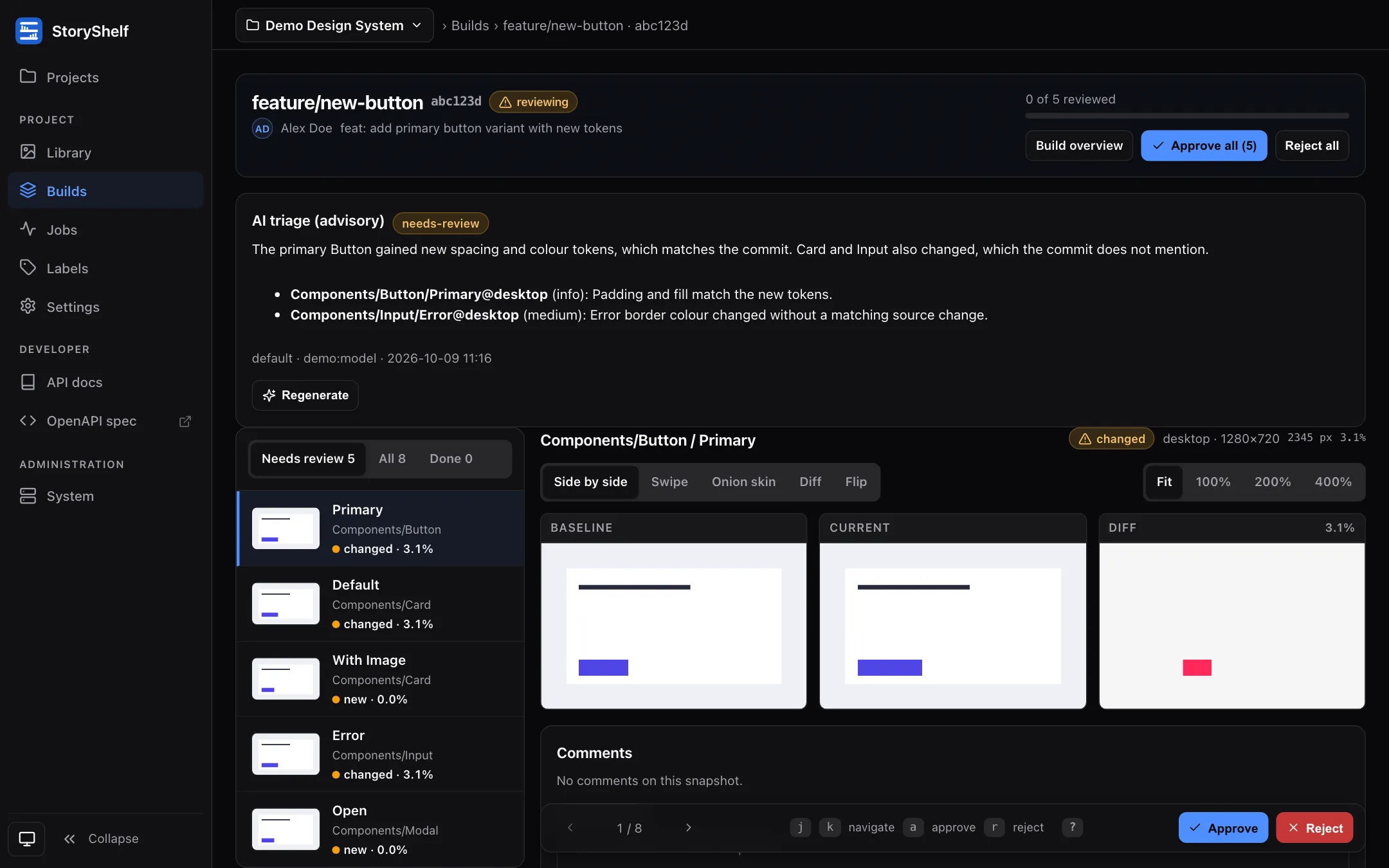
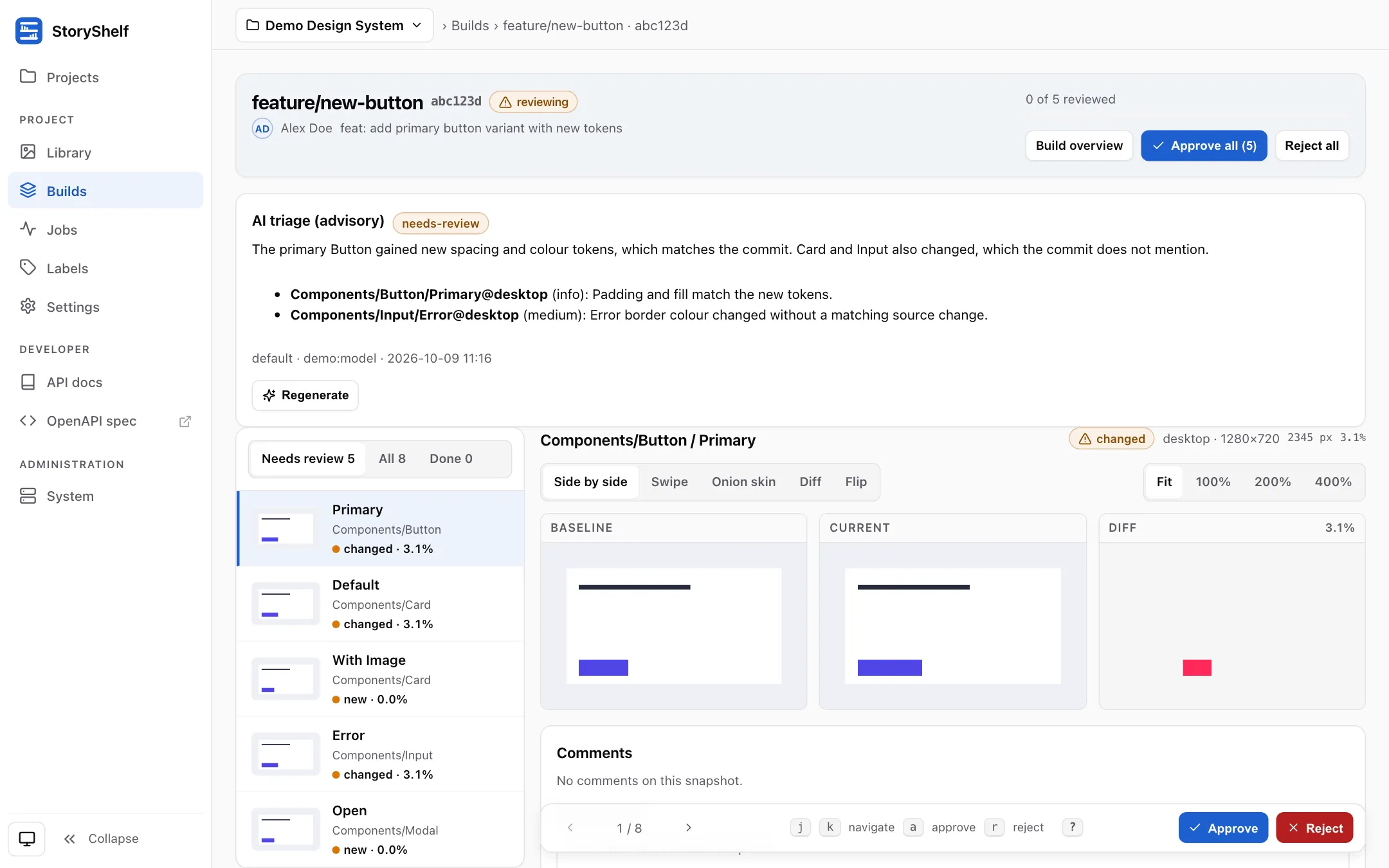
A real review workspace
Filmstrip of changed stories, side-by-side, swipe, onion-skin and flip comparison, pixel-level zoom, and keyboard-driven approve/reject that jumps to the next change.
Scaffold a server
npx storyshelf server initpnpx storyshelf server inityarn dlx storyshelf server initUpload a Storybook build from CI
npx storyshelf uploadpnpx storyshelf uploadyarn dlx storyshelf uploadReview the diffs in your browser and approve or reject each change, or gate merges on the result.
Full walkthrough: Getting started.
A real review workspace
Filmstrip of changed stories, side-by-side, swipe, onion-skin and flip comparison, pixel-level zoom, and keyboard-driven approve/reject that jumps to the next change.
Branch-aware baselines
Baselines per branch with fallback to the default branch. Approve once, auto-approve on main,
and keep long-lived branches with persistent labels.
Server-side capture
Upload your built Storybook; the server renders every story with Playwright (Chromium, Firefox, WebKit) or lightweight Puppeteer. Affected-only capture keeps CI fast.
Published Storybook
Share the latest build at /storybook or a per-project subdomain, gated to public branches.
Merge gate and notifications
Commit statuses for GitHub and GitLab, threaded comments, and Slack, Teams or email alerts when a build needs review.
AI triage and health (optional)
Bring your own model and get a verdict and per-snapshot notes on every build, plus a 30-day project health digest. Advisory only, off by default, secrets redacted.
Agent-ready (MCP)
An MCP server lets Claude Code, Cursor and other agents read builds, diffs and AI triage and comment on reviews. Local over stdio or shared over HTTP, scoped by your existing tokens, and it never approves for you.
Self-host anywhere
Docker Compose locally, or Terraform stacks for AWS, Azure and GCP. Bring your own database and storage; the database is also the capture queue.
Optional and advisory. Connect any model through the Vercel AI SDK (OpenAI, Anthropic, Google, Bedrock, Vertex, Azure, a gateway, or a local model) and StoryShelf will tell you whether a build’s changes look intended, need a human look, or look like a regression, and summarize how healthy each project is.
Agents can read all of it too: the MCP server exposes builds, diffs and triage to Claude Code, Cursor and friends.
Read about AI insights · Set it up · Try it with free models
| Chromatic (SaaS) | StoryShelf (self-hosted) | |
|---|---|---|
| Pricing | 5k snapshots free, then $179/mo per 35k | MIT, unlimited — infra cost only |
| Browsers | Chrome, Firefox, Safari, Edge (cloud) | Chromium/Firefox/WebKit per project + lightweight Puppeteer |
| Hosting | Chromatic cloud only | Your infra — Docker, Fly, Vercel, Lambda, Azure, GCP |
| Data | US/EU regions | Your DB/storage — full residency |
| Lock-in | Proprietary | Open source, standard /api/v1 |
Full breakdown and migration guide: Comparison · Migration.